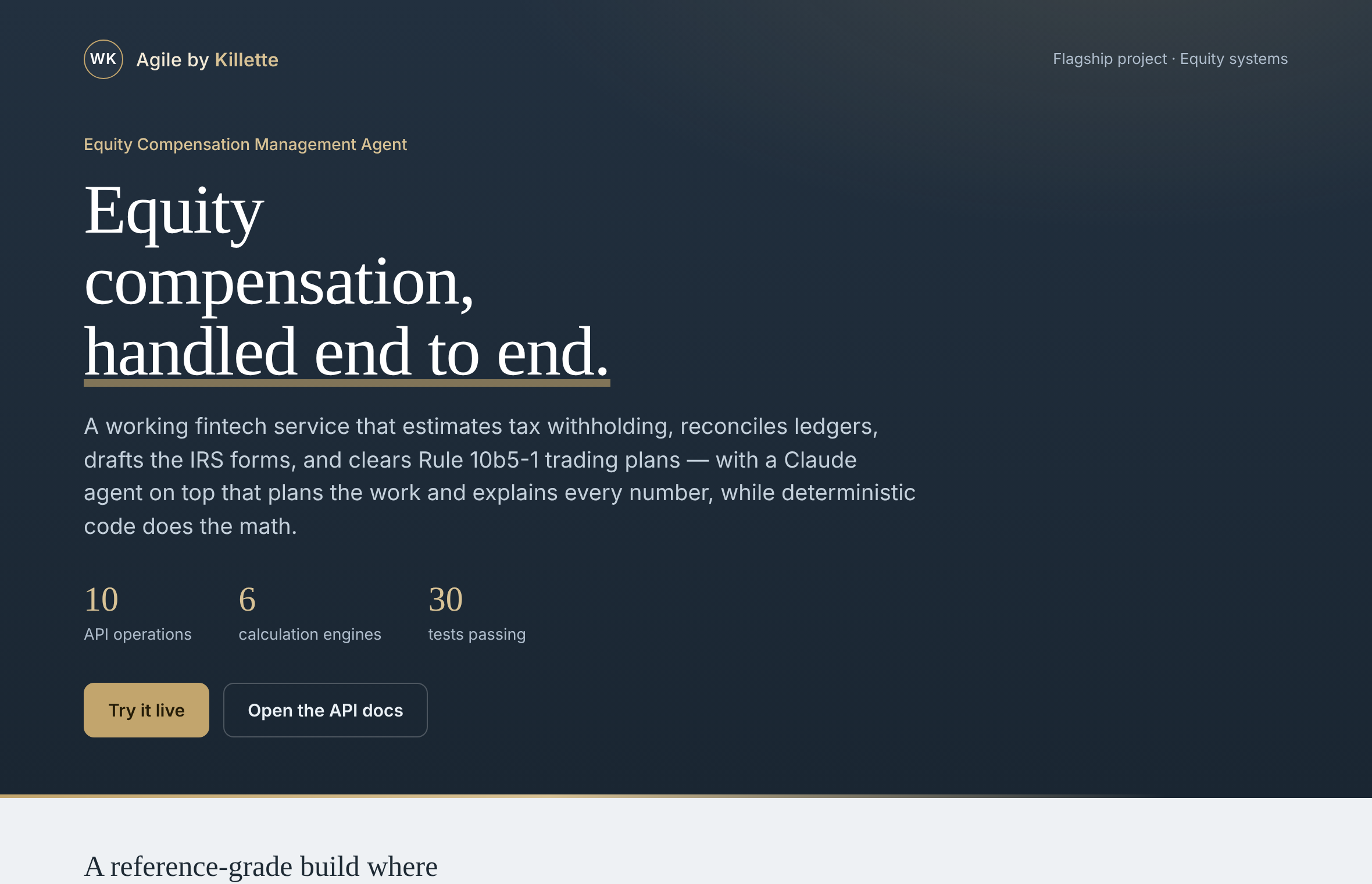
Most "AI for finance" demos ask you to trust a language model with arithmetic and records. This one is built the other way around: Claude decides what to do and explains it in plain English, while audited Python functions do the computing and nothing reaches a ledger or a vendor without human approval. It is the pattern I argue for in AI governance — capability with control — shipped as a real service instead of a slide.
What it handles
Tax withholding
Federal 22%/37% split, state, local and FICA for an RSU release or NSO/ISO/ESPP event — with the shares needed to cover.
Vesting schedules
Cliff and periodic schedules, plus the vested and unvested position as of any date.
Ledger reconciliation
Cap table against payroll and brokerage — field mismatches, missing and duplicate records.
IRS reporting
Draft Form 3921, 3922 and 1099-B objects, including the Form 8949 basis adjustment that prevents double taxation.
Rule 10b5-1 trading plans — the regulatory centerpiece
Validate a plan at adoption and pre-clear individual trades against the SEC's 2023 conditions. The newest and most involved engine in the build (details below).
Claude agent
Ask in plain English; the agent picks the right tool, runs it, and explains the result — it never computes the numbers itself.
The Rule 10b5-1 engine
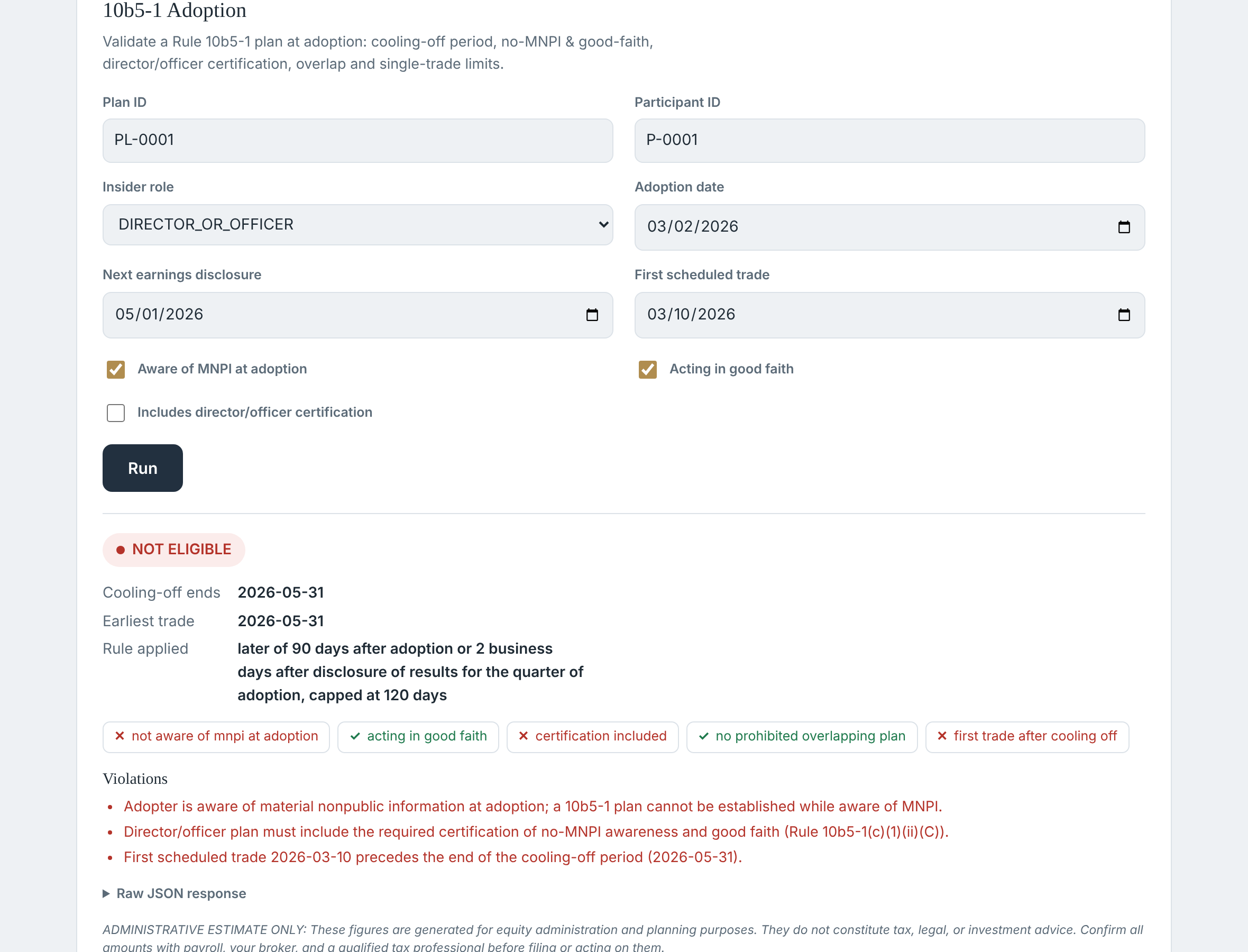
Rule 10b5-1 gives insiders a safe harbor for pre-planned trades — but only if the plan meets a stack of conditions the SEC tightened in 2023. The agent encodes those conditions as deterministic checks and returns a clear verdict with every rule cited.
- Adoption check: cooling-off period (the later of 90 days or two business days after results, capped at 120 for directors and officers; 30 days for others), no-MNPI and good-faith conditions, the director/officer certification, and the overlapping-plan and single-trade-plan limits.
- Trade pre-clearance: cooling-off elapsed, plan active, outside company blackout windows, and consistent with the plan's own scheduled instructions.
- Honest scope: it checks the structural conditions against facts the user asserts — it does not decide whether someone truly holds material nonpublic information, and it is not legal advice.
How it's built
- A FastAPI service with ten operations.Tax, vesting, reconciliation, three IRS forms, two 10b5-1 endpoints, an approval-gated integration payload, and a conversational agent — all documented in an OpenAPI 3.1 spec with an interactive Swagger UI.
- Six deterministic engines.Every figure comes from audited Python using exact decimal arithmetic. The language model is never in the numeric path.
- Claude on top, as an orchestrator.A tool-use loop lets Claude read a plain-English request, choose the right endpoint, run it, and explain the result — the capability layer, with the math layer locked down beneath it.
- Built to run.PostgreSQL schema, Docker Compose, and a 30-test suite with hand-calculated expected values. It starts with one command.
See it, or talk through it
Built on fictional data as a portfolio reference. Explore the running tool, read the source, or let's talk about bringing this kind of governed AI to your delivery.
Launch the live sandbox View the source Book a governance callThe sandbox runs on a free instance that sleeps when idle — the first load may take 30–60 seconds to wake. Built on fictional data.