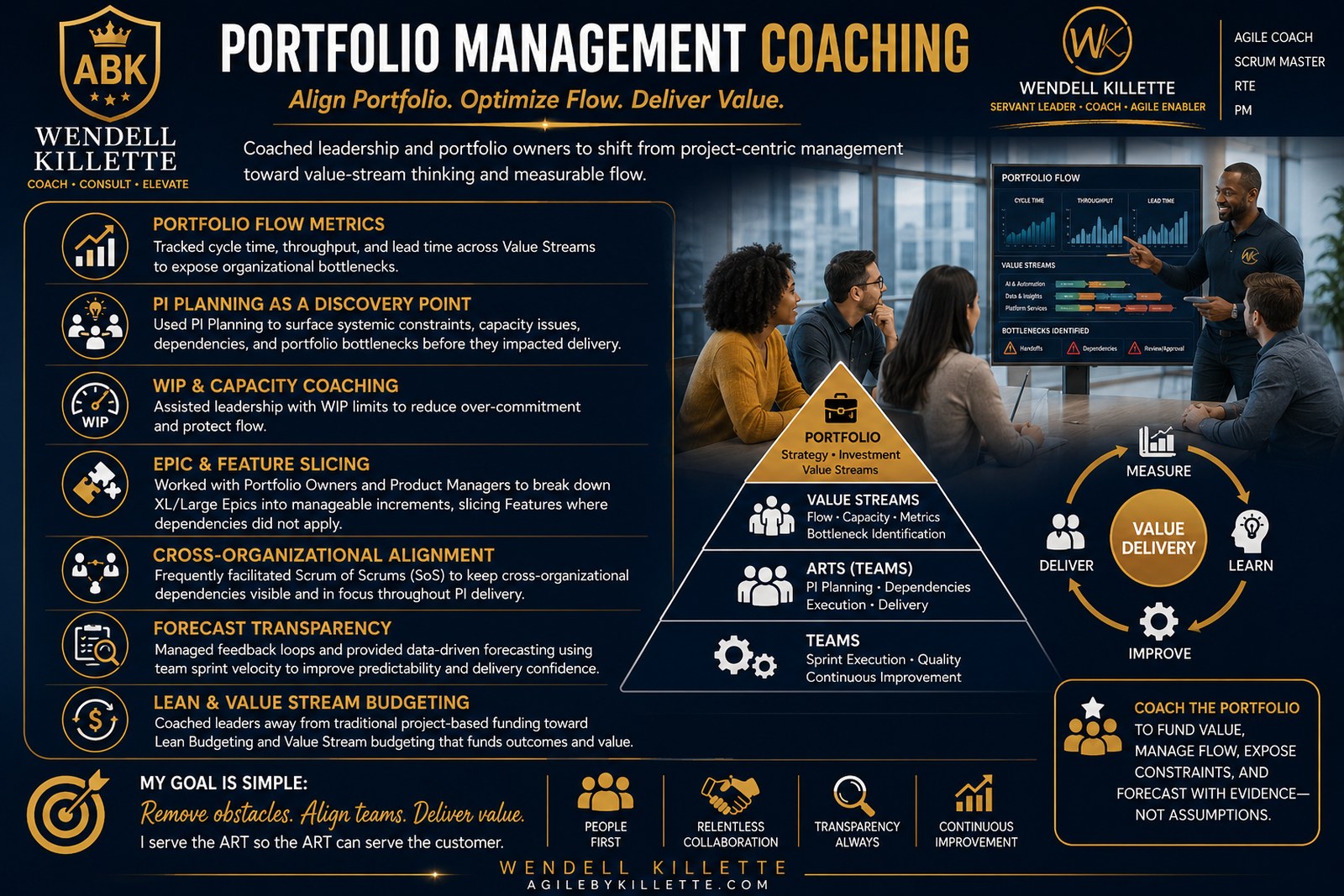
This is Release Train Engineer work. In practice, Scrum Masters are asked to do it anyway — and on two financial-services trains, I did. What follows is the actual work, not the job-description version.
Most of it happens in PI Planning
Portfolio management is not a reporting exercise that runs quietly in the background. It is a set of commitments — and PI Planning is where they get made. That is the event where expectations are ironed out in the open, in front of the people who have to live with them.
Constraints get named. Capacity gets agreed rather than assumed. Dependencies get mapped while the teams who own both ends are still in the room. Mitigation gets an owner before anyone commits. What leaves the event is not a schedule — it is a promise the portfolio can actually keep.
What gets committed during planning
Constraints & Bottlenecks
- Surface the systemic constraints and capacity issues that individual team boards hide.
- Put an owner against each one and confirm mitigation before the PI commits.
WIP & Capacity
- Agree WIP limits with leadership in the room, not after the over-commitment.
- The portfolio commits to what it can finish — and says so out loud.
Epic & Feature Slicing
- Work with Portfolio Owners and Product Managers to break XL and Large epics into manageable increments.
- Slice features where dependencies do not apply, so the commitment is deliverable rather than aspirational.
Cross-Organizational Alignment
- Map dependencies while both ends are still at the table.
- Then keep them in focus through the PI with Scrum of Scrums — the standing forum, not an occasional one.
What runs between planning events
Portfolio Flow Metrics
- Cycle time, throughput and lead time, read across value streams rather than per team.
- Team velocity tells you how a team is doing. It does not tell you where the organization is stuck — that answer lives one level up.
Forecast Transparency
- Data-driven forecasting built from team sprint velocity, not from optimism.
- Feedback loops that re-cut the forecast as sprints close, so leadership plans against evidence.
And the conversation nobody starts
Lean & Value Stream Budgeting
Traditional project-based funding quietly guarantees the problems above. It funds a plan, locks the money to a scope, and forces every honest mid-course correction into a change-request fight. Coaching leaders toward Lean budgeting and value stream budgeting funds outcomes instead — which is what makes the flow metrics, the WIP limits and the slicing worth doing at all.
Where I have done this
Charles Schwab · 2025–2026
- Senior Scrum Master carrying RTE-level portfolio responsibilities across three teams.
- Flow metrics above the team board, WIP limits agreed with leadership, XL epics sliced with Portfolio Owners and Product Managers.
LPL Financial · 2021–2023
- Senior Scrum Master / RTE across the ART.
- Portfolio flow reporting, dependency management through Scrum of Scrums, and the move off project-based funding.
See both roles in full on the track record →
The mindset
Coach the portfolio to fund value, manage flow, expose constraints, and forecast with evidence — not assumptions. My goal is simple: remove obstacles, align teams, deliver value. I serve the ART so the ART can serve the customer.
Is your portfolio funding plans or outcomes?
If your teams are busy and delivery still slips, the constraint is usually above the team board. Start with a conversation.
Book a conversation → Call 469-774-2233 Message on LinkedInEmail app didn’t open? Write to wendell@agilebykillette.com