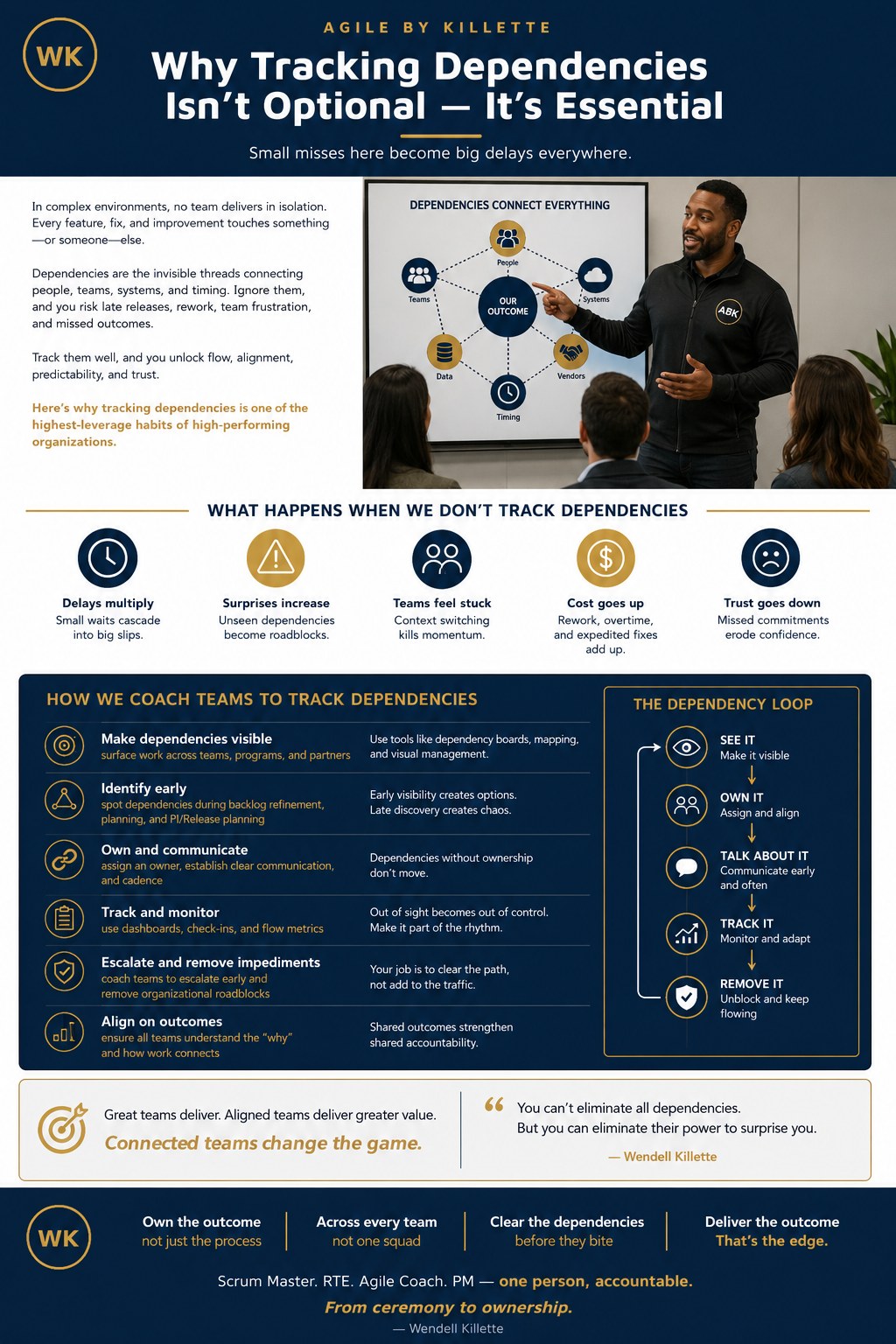
Dependencies are where delivery quietly dies. Not in the standup, not on the burndown — in the gap between two teams who each assumed the other had it. You don't manage that on a spreadsheet. You coach it.
Why this is the highest-leverage habit I coach
In complex environments, no team delivers in isolation. Every feature, fix, and improvement touches something — or someone — else. Dependencies are the invisible threads connecting people, teams, systems, and timing. Ignore them and you get late releases, rework, frustrated teams, and missed outcomes. Track them well and you unlock flow, alignment, predictability, and trust.
The seven coaching moves
- Make them visible.One shared board — a program board, a dependency wall, whatever the org will actually look at — before they surprise you. Out of sight becomes out of control.
- Map them early.In refinement and PI planning, not mid-sprint. Early visibility creates options; late discovery creates chaos.
- Give each one an owner.Who owes what to whom, and by when. A dependency without a name attached doesn't move.
- Broker team to team.Coach the conversation directly between the teams. Don't relay it through managers — every hop adds delay and drops context.
- Sequence across the train.Order the work so no team sits waiting or builds something twice. This is most of what an RTE actually does.
- Design them down.Cross-functional, value-aligned teams that own more end to end. The best dependency is the one that no longer exists.
- ROAM the risk.Resolved, Owned, Accepted, or Mitigated. None left silent. A dependency with no ROAM status is a countdown nobody's watching.
The dependency loop
See it (make it visible) · own it (assign and align) · talk about it (communicate early and often) · track it (monitor and adapt) · remove it (unblock and keep flowing). Then round again — because the web changes every increment.
The part that's actually hard
Anyone can keep a dependency log. The hard part is getting teams to own their dependencies — to walk across the org chart and have the conversation before the date slips. That's culture, and culture is coached, not configured. It's the same move as everything else I do: from ceremony to ownership, even across the org chart.
Where this shows up in delivery
- PI Planning & the program board. Dependencies get drawn, owned, and sequenced in the room, while changing them is still cheap.
- Refinement. "What does this touch?" is a refinement question, not a sprint-day discovery.
- Flow metrics. Blocked time and wait time tell you what the log won't — where the web is actually pulling.
- Vendor and platform work. The dependencies that hurt most are usually the ones outside your train entirely.
- Release readiness. Integration, environments, and test data are dependencies too — and they're the ones that bite at go/no-go.
Great teams deliver. Aligned teams deliver greater value. Connected teams change the game.
Dependencies eating your dates?
If your teams keep discovering each other mid-sprint, this is fixable — and faster than you'd think. Let's look at your program board together.
Book a conversation → Call 469-774-2233 Message on LinkedInEmail app didn’t open? Write to wendell@agilebykillette.com