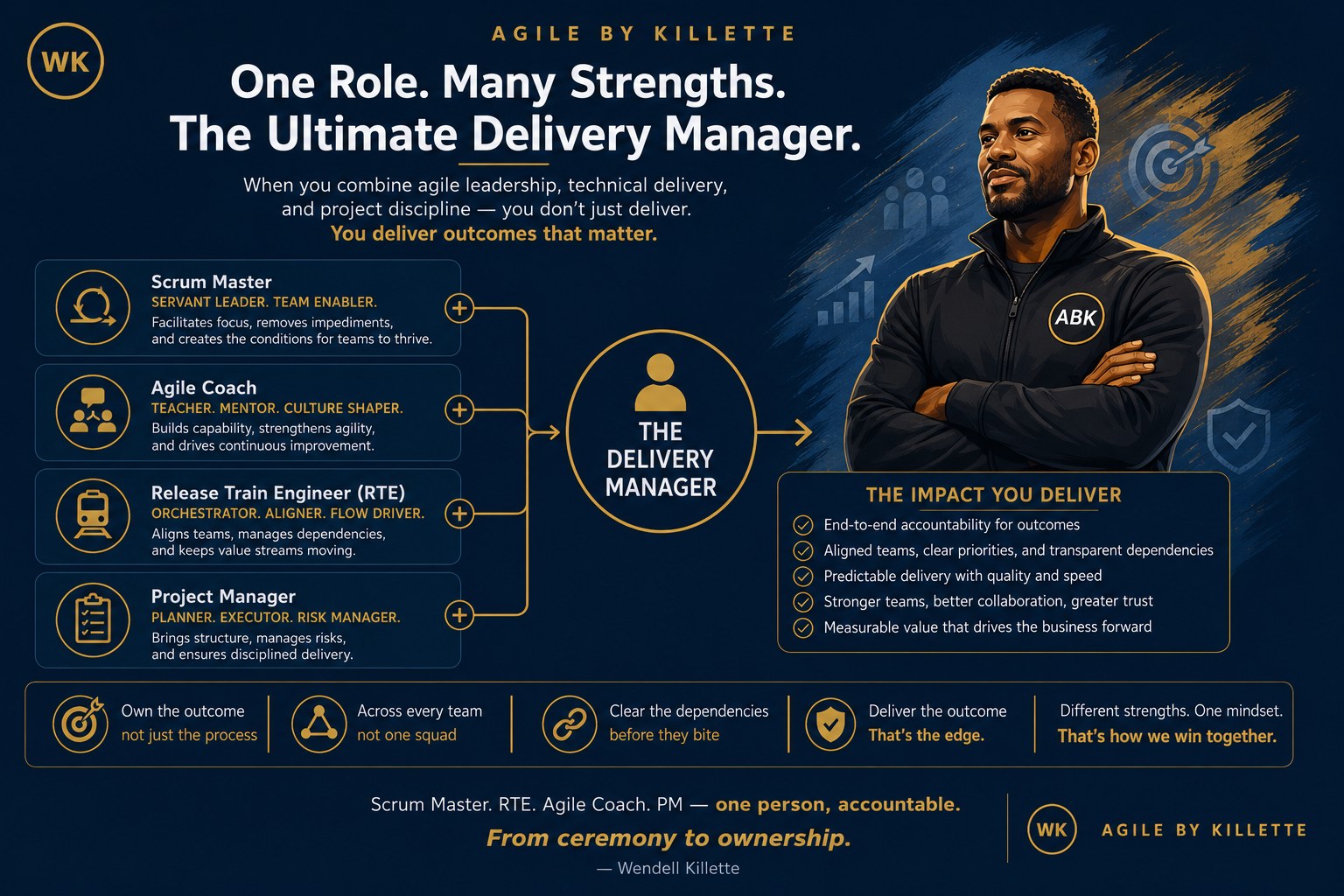
A Scrum Master runs the team. An RTE runs the train. A Coach grows the people. A PM owns the plan. A Delivery Manager is accountable for all of it landing — and I have been all four of those, for two decades.
The seven moves of the job
- Own the outcome, not just the process.The ceremonies are means. The commitment is that the thing ships, works, and moves the number the business cared about. One name on it.
- Work across every team, not one squad.Delivery risk almost never lives inside a single team. It lives in the seams — integration, sequencing, shared platforms, vendors.
- Clear the dependencies before they bite.Visible, owned, sequenced, ROAMed. This is the single biggest lever on a date. See how I coach it →
- Govern without the drag.RAID, forecasting, and status that leaders can act on — delivered at a cadence, not as a fire drill. PM-grade governance without turning the teams into a reporting factory.
- Guard release readiness.Test coverage, environments, data, NFRs — performance, security, reliability. Go/no-go is a decision with evidence behind it, not a hope with a calendar invite.
- Prove it with data.Cycle time, WIP, throughput, predictability, DORA. If the improvement isn't in the metrics, it didn't happen.
- Grow the team as you go.The delivery that lasts is the one the teams can run without me. Coaching isn't a side activity in this role — it's how the outcome becomes repeatable.
Four roles, one accountability
Scrum Master
Servant leader, team enabler. Facilitates focus, removes impediments, and creates the conditions for teams to thrive.
Agile Coach
Teacher, mentor, culture shaper. Builds capability, strengthens agility, and drives continuous improvement.
Release Train Engineer
Orchestrator, aligner, flow driver. Aligns teams, manages dependencies, and keeps value streams moving.
Project Manager (PMP-trained)
Planner, executor, risk manager. Brings structure, manages risk, and ensures disciplined delivery.
Most Delivery Managers arrive one of two ways: an ex-PM learning Agile, or an ex-Scrum-Master learning governance. I am already both — which means neither half of this job is the half I would be growing into.
The differentiator: a 40-year quality spine
Where I've done it
Twenty-plus years across financial services, telecom, aviation, healthcare, and federal programs — Charles Schwab, USAA, LPL Financial, AT&T, American Airlines, Cigna, and the IRS. Regulated, audited, high-stakes delivery, with zero audit findings across regulated cycles. Predictability lifted from 70% to 92%. Cycle time cut 30%. Sustained delivery of 105–125% of planned work.
Need one accountable owner for delivery?
If delivery is spread across several teams and nobody owns whether it actually lands, that's the gap I fill. Fractional or embedded — let's talk about the shape that fits.
Book a conversation → Call 469-774-2233 Message on LinkedInEmail app didn’t open? Write to wendell@agilebykillette.com